
Serving up systems to feed the community
Food is not just about nutrition, it's also about dignity, access and connection.
We’re excited to share that Healthy Living Platform has been featured in the latest edition of Lambeth Voices!
Lambeth Voices is a community zine produced by Millennium Community Solutions, delivering inclusive news for an inclusive borough. Our feature appears on pages 10–11 as part of a special edition spotlight on We Are 336, the vibrant community space where the HLP Hub is based.
You can pick up a printed copy in community spaces across Lambeth or read the latest edition online here: https://heyzine.com/flip-book/105922031c.htm
Below, you can read the full article as it appears in Lambeth Voices.
Healthy Living Platform: Food, Infrastructure and Community at the Heart of Lambeth
Healthy Living Platform began in 2018, commissioned through the Lambeth Early Action Partnership (LEAP) to work with families and early years children around diet and nutrition. That early work focused on practical, everyday questions — what a healthy balanced plate looks like, how food supports development, and supporting breastfeeding peer support groups.
Since then, the organisation has grown into a borough-wide community food charity supporting people of all ages and backgrounds across Lambeth. What has remained constant is a clear belief: food is not just about nutrition — it is about dignity, access and connection. When food is done well, it becomes a gateway to wider support and stronger communities.
Working through communities, not around them
When the Covid pandemic hit, Healthy Living Platform was already running small-scale food activities, including veg bag giveaways and cooking sessions with parents and children using small amounts of surplus food. As the crisis unfolded, Lambeth Council commissioned the organisation to support emergency food distribution. Like many services at the time, the response had to be built quickly and under pressure.
As the work developed, an important insight emerged. Some people were consistently being missed — those who were isolated, known only to specialist services, or hesitant to access formal food aid. The most effective way to reach them was not directly, but through the community organisations they already trusted.
This led to a fundamental shift. Rather than distributing food directly to individuals, Healthy Living Platform began working in partnership with community groups — children’s centres, SEND parent networks, women’s services, youth clubs, homeless outreach teams, probation services and unpaid carers’ organisations — supporting them to use food as part of their existing support offer.
Today, over 40 community groups receive food weekly through this model, collectively supporting around.
The Surplus Food Hub: making food redistribution work
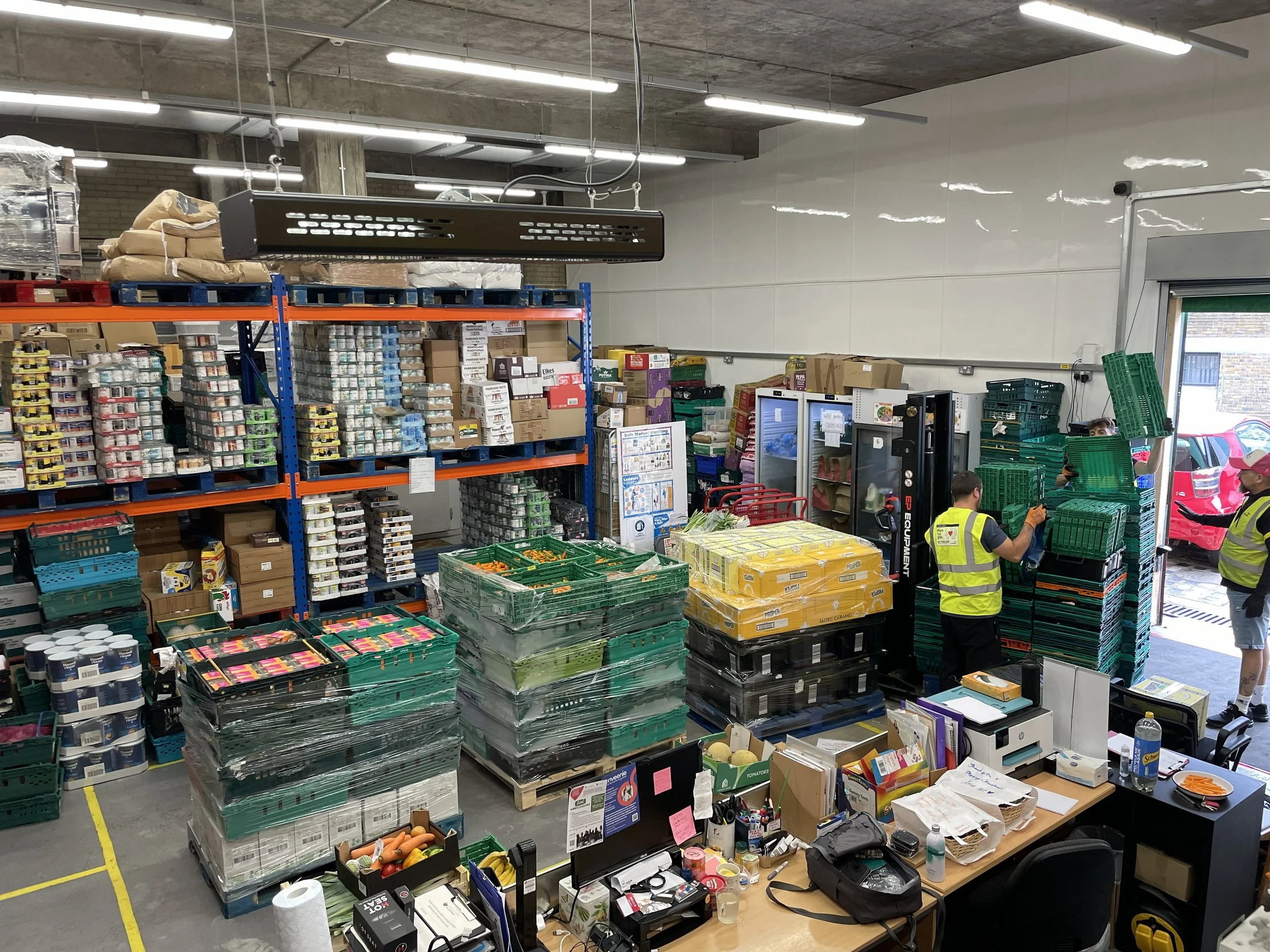
At the centre of this work is the Surplus Food Hub, now based at We Are 336 on Brixton Road — a building run by Lambeth Accord that brings together a range of community-focused organisations. Healthy Living Platform rents both the Hub space and the Community Kitchen within the building, working alongside other organisations based there.
Before moving to 336 in December 2022, the Hub operated from the basement of Brixton Recreation Centre as an emergency food distribution centre. Although large, it was logistically challenging: access was limited, pallet trucks could not fit through doors, and the work relied heavily on manual handling. This restricted how much food could be moved and distributed and the speed at which we could work.
The move to 336 transformed what was possible. A disused car park was converted, with grant funding, into a small but highly efficient food warehouse. Step-free access and a loading bay allow food to be moved quickly and safely. Racking and a pallet stacker make it possible to now work vertically and at scale, while walk-in fridges and freezers have more than doubled chilled and frozen capacity. As a result, the Hub increased its operational capacity by nearly 40% in the first year alone.
The Hub acts as a kind of sorting office. Large volumes of food arrive, often unpredictably, and the team uses detailed local knowledge to make sense of it — matching food types, quantities and formats to the specific needs of each group. When a new organisation is onboarded, the team learns how many households they support, what storage they have, any cultural or dietary requirements, and whether food needs to be ready-to-eat or suitable for cooking at home.
Whether food is destined for a soup kitchen, a family food share, a youth club or homeless outreach, the aim is the same: to turn surplus into something balanced, appropriate and useful. All distributions follow the NHS Eatwell Guide to ensure a healthy mix of food.
This work is delivered by a small team of staff, supported by volunteers when available — far fewer than during the pandemic, but still making a significant impact.
Pantries: dignified access to affordable food
As a channel for the food from the Hub, Healthy Living Platform has 3 community pantries — affordable food shops that offer people choice and consistency, helping them avoid crisis and reduce reliance on food banks.
Pantries offer a good range of fresh produce, store cupboard essentials and, when available, treats and extras. Members pay a small weekly amount based on how much they want to take, and that income is reinvested into the pantry to buy popular items and culturally relevant foods such as plantain, sweet potato and Scotch bonnet peppers — ingredients that are often expensive but deeply important to people’s diets and identities.
Pantries are volunteer-run and rooted in their local communities. Over time, volunteers get to know members well, creating spaces that feel welcoming and familiar rather than transactional. Food often becomes the entry point to wider support.
Health and wellbeing services, housing advice, MP surgeries and other outreach services regularly pop-up at pantry sessions to engage with the community whilst they are waiting for their turn to shop — reflecting one of the organisation’s core aims: strengthening community connection and cohesion through food.
Education, skills and pathways
Education and training are another key strand of the work. Through the Food Ambassadors programme, participants build confidence in food preparation, nutrition and safe working practices, gaining Level 2 Food Hygiene qualifications. These skills enable people to volunteer in community kitchens, support local food projects or move towards paid work in the food industry or local activities.
The Community Kitchen at 336 — originally the building’s canteen — was reactivated in 2022 with council investment. HLP has now developed the kitchen into a flexible space supporting training, catering, community meals and small food businesses.
Food Ambassadors use the kitchen to build experience, while community groups can hire it at discounted rates. It is also used for private and commercial hires, helping to generate income to sustain the space. The kitchen completes a full food cycle: surplus arriving through the Hub can be cooked, shared, portioned or used in training, maximising both nutritional and social value.
A shared community asset
Being based at We Are 336 allows Healthy Living Platform to work alongside other organisations in the building. This includes catering for events with DASL, supporting Young Carers Hub with healthy lunches for the HAF summer programme, providing drinks and snacks for Keyring’s Friday social groups, referring residents to Community Tech Aid for donated technology, and sharing learning and space with projects such as Share Kitchen.
These informal collaborations strengthen the building’s role as a community asset — more than the sum of its parts.
Looking ahead
The Surplus Food Hub was initially funded by Lambeth Council, but that funding ended in 2025. Healthy Living Platform is now seeking long-term, sustainable investment to secure the Hub beyond April 2026. A campaign, Secure the Hub, has been launched to highlight the importance of the infrastructure, the partnerships it supports, and the impact it enables across Lambeth.
This is a critical moment. The systems, relationships and physical infrastructure are in place, but without sustained investment, they are at risk. With it, 336 can continue to function as a vital community resource — supporting healthier diets, stronger connections and more resilient neighbourhoods for years to come.